Everything Student

How to Jump-Start a Car

The right order to connect jumper cables, so you stay safe and don't damage either car.

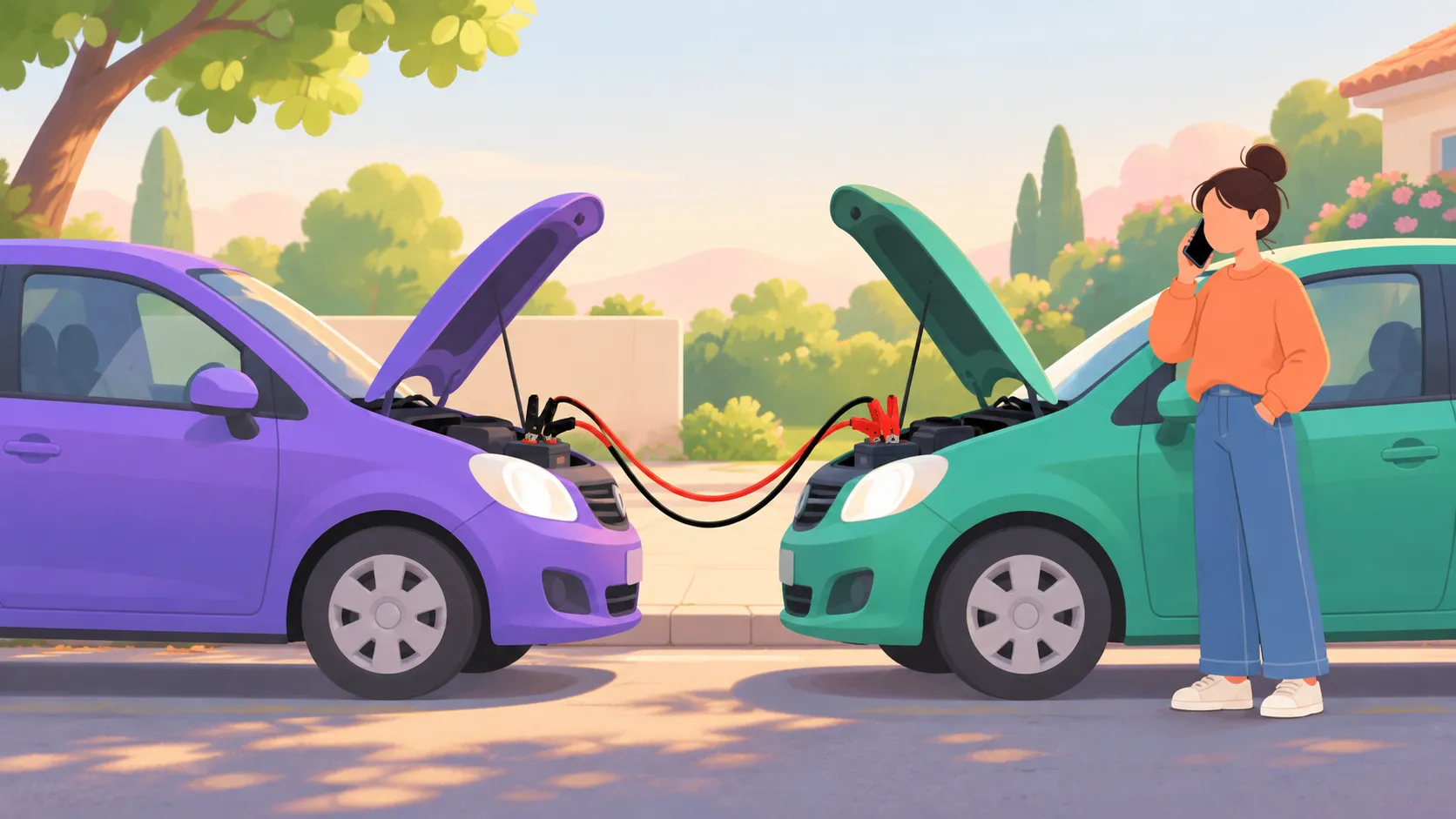
Illustration of two cars parked nose to nose with their hoods open, connected by red and black jumper cables, while a person makes a phone call.

Quick Start

The short version. The details, tips, and FAQ are below.

  1. Park the working car close, without the cars touching, and turn both off.
  2. Red clamp to the dead battery’s +, then the other red to the good battery’s +.
  3. Black clamp to the good battery’s −, then the last black to bare metal on the dead car.
  4. Start the good car, wait a few minutes, then start the dead one.
  5. Remove the clamps in reverse order and drive for 20–30 minutes.
Dead batteryGood battery12V12V++−−Not hereBare metal (engine block)
The four connections in order, ending on bare metal, never on the dead battery's negative terminal.
  1. Positive (red) clamp → dead battery's positive terminal — Connect this one first. The positive terminal is usually marked "+" and is often larger than the negative one.
  2. Other positive (red) clamp → good battery's positive terminal — Connect the same red cable's other clamp to the running car's positive terminal.
  3. Negative (black) clamp → good battery's negative terminal — Connect the black cable to the negative terminal on the GOOD battery only — not the dead one yet.
  4. Final negative (black) clamp → bare metal on the dead car, not its battery — Ground the last connection on an unpainted metal surface on the dead car's engine block or frame, away from the battery. This is the safety-critical step: grounding directly on the dead battery's own negative terminal risks a spark igniting hydrogen gas the battery may be venting.

A dead battery is one of the most common reasons a car won’t start, and jump-starting it usually takes about ten minutes — as long as you connect the cables in the right order. The diagram above shows where each clamp goes.

What You’ll Need

  • Jumper cables, or a portable jump-starter pack.
  • A second car with a working battery (not needed with a portable pack).
  • Your car’s owner’s manual — some cars have special jump-start points under the hood.

Warning: Don’t jump a battery that’s cracked, swollen, leaking or frozen, and never smoke or hold a flame near a battery. If you see any of these signs, call roadside assistance instead.

Step by Step

  1. Park the working car close — near enough for the cables to reach, but the two cars must not touch. Turn both engines off, put both in park (or neutral with the parking brake on) and turn off lights and radios.
  2. Red clamp on the dead battery’s positive (+) terminal. The positive terminal is marked ”+” and often has a red cover.
  3. Other red clamp on the working battery’s positive (+) terminal.
  4. Black clamp on the working battery’s negative (−) terminal.
  5. Last black clamp on bare, unpainted metal on the dead car’s engine block or frame, away from the battery — not on the dead battery’s negative terminal. This keeps any spark away from the battery.
  6. Start the working car and let it run for a few minutes.
  7. Try to start the dead car. If it doesn’t start, wait a few more minutes and try again. After several tries with no luck, the problem may be something other than the battery.
  8. Remove the clamps in the reverse order: the last black clamp first, the first red clamp last. Don’t let the clamps touch each other while any are still connected.

After a Jump-Start

Keep the car running: drive it for at least 20–30 minutes so the alternator can recharge the battery. If it dies again soon after, the battery may need replacing — many auto parts stores test batteries for free.

If You Don’t Have Another Car

A portable jump-starter pack works the same way without a second car, and many are small enough to keep in the trunk — follow the instructions printed on it. Otherwise, call roadside assistance through your car insurance, a membership service or your car’s manufacturer.

Common Mistakes

  • Connecting the clamps in the wrong order.
  • Putting the last black clamp on the dead battery instead of on bare metal.
  • Letting the two cars touch, or letting the clamps touch each other.
  • Turning the car off right after it starts, before the battery has had time to recharge.
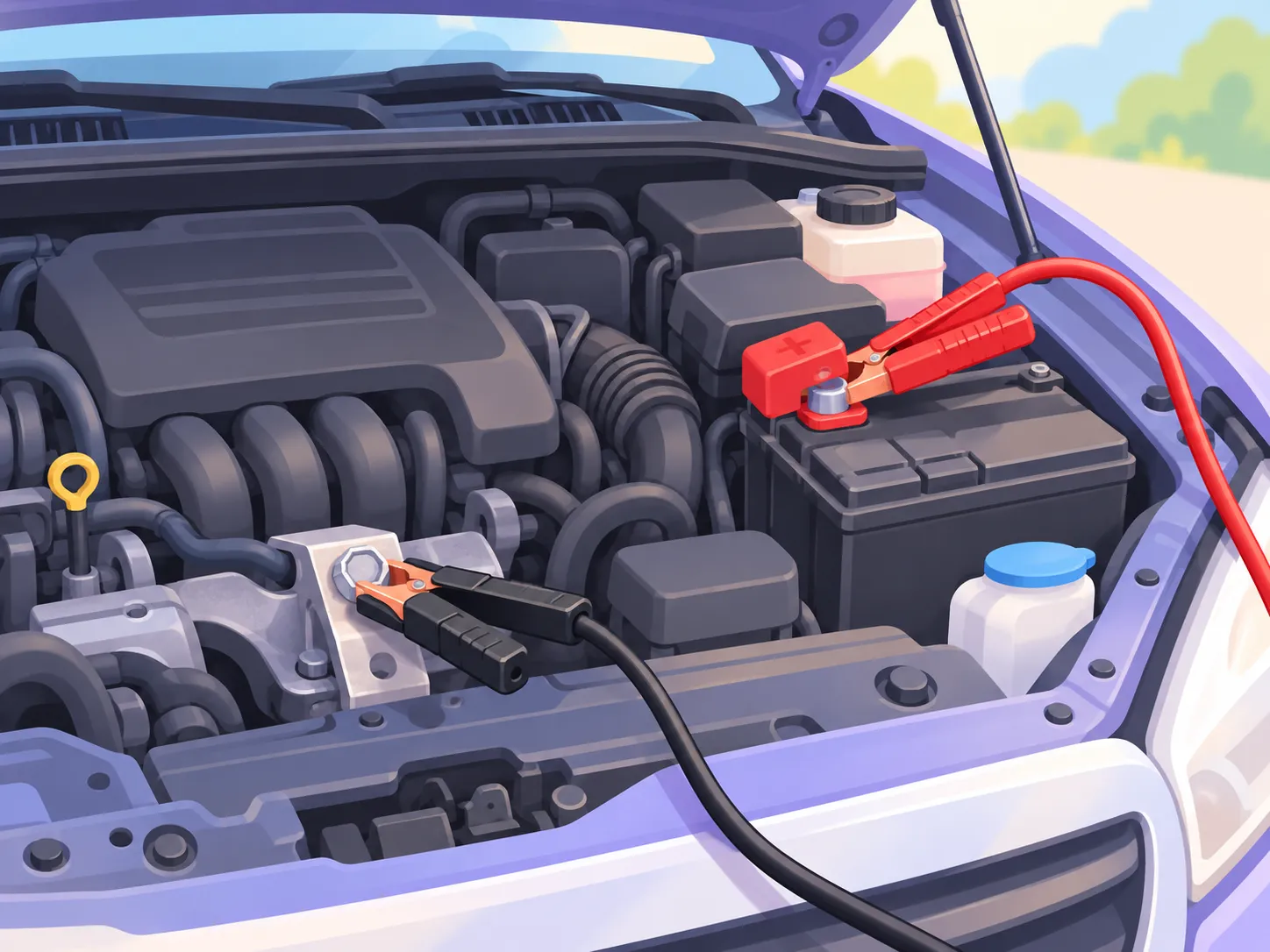
Illustration under an open hood: the red clamp on the battery’s positive post and the black clamp on a bare metal bracket on the engine, away from the battery.

Frequently Asked Questions

What order do the cables actually go in?

Red (positive) to the dead battery's positive terminal first, then red to the good battery's positive terminal. Then black (negative) to the good battery's negative terminal. Last, connect the final black clamp to an unpainted metal surface on the dead car's engine block or frame — not its battery's negative terminal — to avoid sparking near the battery itself.

How long do I need to wait before trying to start the car?

Let the dead battery charge for a couple of minutes with the good car's engine running, then try starting the dead car. If it doesn't start on the first try, give it another few minutes and try again — some batteries need more charging time than others before they'll turn over.

What if I don't have another car to jump from?

A portable jump-starter battery pack works the same way without needing a second vehicle, and many are small enough to keep in a trunk. If you don't have one and can't find another car, roadside assistance (through your insurance, a membership like AAA, or your car's own manufacturer program, if you have one) is the reliable fallback.

Is it ever unsafe to jump-start a battery?

Yes — don't attempt it if the battery case is visibly cracked, swollen, or leaking, or if you see ice or frost on a battery that may have frozen (a frozen battery can rupture when charged). Call for roadside assistance instead in any of these cases rather than connecting cables to it.

Can I jump-start between vehicles with different voltage systems?

Only if both use the same voltage system — most passenger cars and light trucks are 12-volt, but some larger vehicles use a different system. Jump-starting between mismatched voltage systems can cause serious electrical damage, so when you're not sure, don't attempt it.

What if the car still won't start after a jump?

The battery itself may be too old or damaged to hold a charge, or the real problem might not be the battery at all (a failing starter or alternator, for example). If it started but died again shortly after, or didn't start after a couple of tries, it's worth having it tested or towed rather than continuing to attempt jumps.

Sources

Home