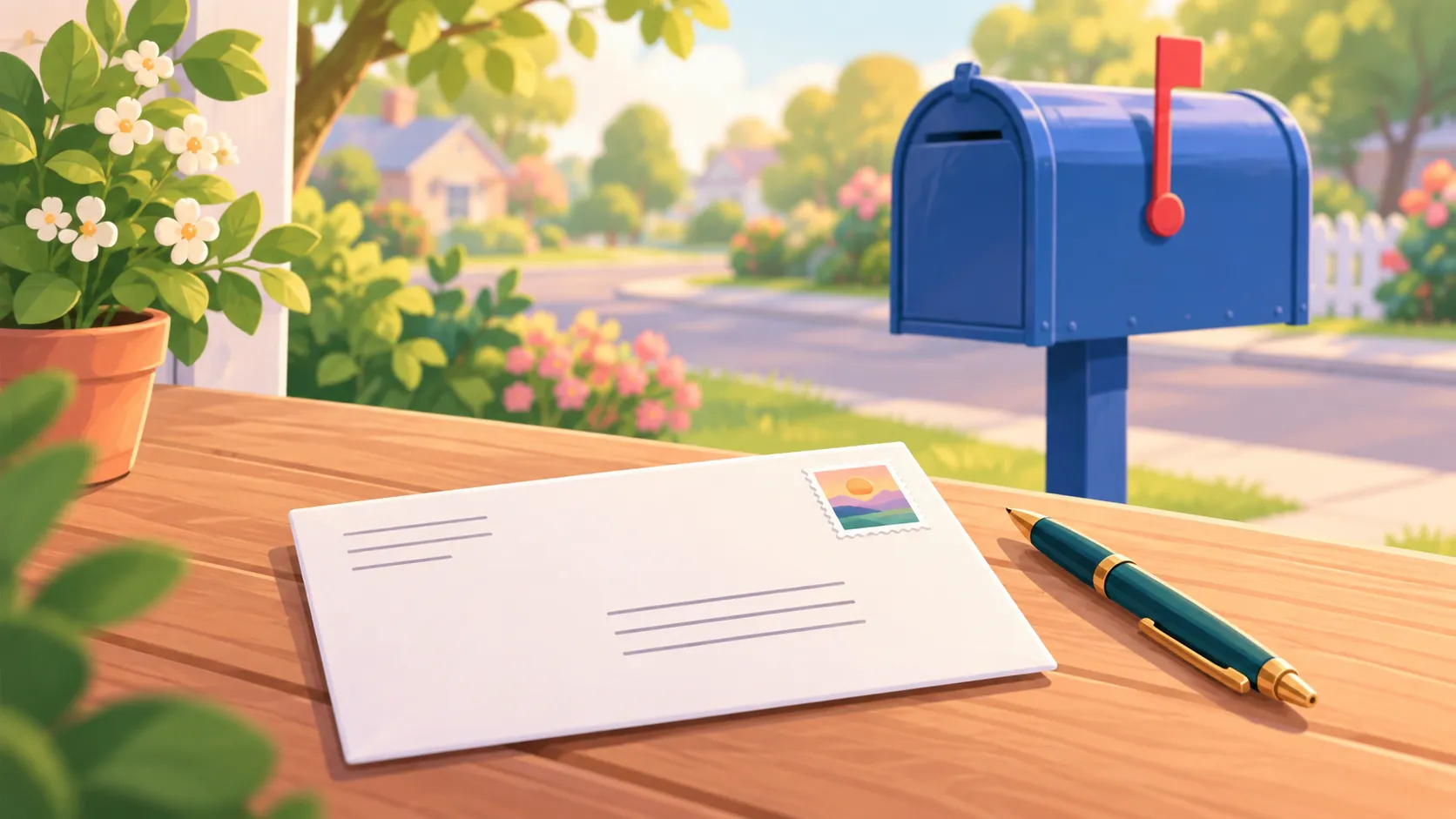
An envelope needs three things in three places: your address, the recipient’s address, and a stamp. Get those right and your letter arrives — and if it can’t be delivered, it comes back to you instead of being thrown away.
Step by Step
- Return address — your name and address in the top-left corner, in the same three-line format as the recipient’s. This is the only way an undeliverable letter finds its way back to you.
- Recipient address — in the middle of the envelope, in this order:
- the recipient’s full name;
- the street address, with any apartment or unit number on the same line (e.g. “456 Oak Ave Apt 3”);
- the city, the two-letter state abbreviation, and the ZIP code (e.g. “Rivertown, IL 60614”).
- Stamp — in the top-right corner. Mail-sorting machines look for postage there.
Tip: Print clearly in dark ink. Handwriting is fine, but capital letters are easiest for sorting machines and carriers to read.
Common Mistakes
- Putting the stamp anywhere other than the top-right corner.
- Leaving off the apartment or unit number — one of the most common reasons mail is delayed in a building with many units.
- Guessing a ZIP code. A wrong one can send the letter to the wrong post office first.
- Skipping the return address to save time. It’s exactly what you’ll wish you had if the letter can’t be delivered.
How Many Stamps You Need
A standard letter in a regular rectangular envelope, up to one ounce, needs one First-Class “Forever” stamp. Thick cards, square or oddly shaped envelopes, and heavier letters need extra postage. If you’re not sure, a post office counter can weigh it for you.
If You Don’t Know the ZIP Code
USPS has a free online ZIP code lookup by street address (other countries’ postal services offer the same for postal codes). Look it up instead of guessing.
Mailing Internationally
A few things change when you mail a letter to another country:
- The destination country goes on its own last line, in capital letters and in English (e.g. “FRANCE”).
- Many countries order the lines differently (for example, the postal code before the city). Write the address the way the destination country expects it.
- International letters need international postage — a Global Forever stamp covers a standard one-ounce letter from the U.S.